

Choosing the right prospecting methods can make or break your pipeline. For B2B SaaS companies from Seed to Series C, the stakes are high. You need strategies that scale without burning through resources or overwhelming your team. This article breaks down a clear framework for evaluating prospecting approaches, explores proven tactics dominating 2026, and provides benchmarks to set realistic goals. You'll learn how to define your ideal customer profile, leverage AI-driven intent data, and make informed decisions about which methods fit your stage and resources.
Table of Contents
- Key takeaways
- Establishing your prospecting criteria: defining the ideal customer profile (ICP)
- Top prospecting tactics for B2B SaaS in 2026: AI-driven intent and sales-led outreach
- Prospecting outreach benchmarks: cold email and cold call performance in 2026
- Handling edge cases: founders' role in early outbound and prioritizing low-hanging fruit
- Comparison of prospecting approaches: criteria, tactics, and use cases
- Maximize your prospecting results with Leadgami
- FAQ
Key Takeaways
| Point | Details |
|---|---|
| Narrow ICP focus | A clearly defined ideal customer profile guides targeting, prioritization, and resource allocation across Seed to Series C B2B SaaS. |
| AI intent advantage | AI driven intent data combined with sales led outreach outperforms marketing only approaches and accelerates pipeline creation. |
| Email reply benchmarks | Cold email reply rates average around 4.2 percent, with top performers reaching six to nine percent. |
| Founder led outbound | Founders often take the reins on early outbound outreach to validate product market fit before scaling. |
| Structured prospecting framework | A systematic approach uses clear ICP criteria, proven tactics, and stage specific choices to align resources with goals. |
Establishing your prospecting criteria: defining the ideal customer profile (ICP)
Your ICP is the foundation of every successful prospecting effort. Without a clear definition, your team wastes time chasing leads that will never convert. Start by identifying firmographic attributes that predict product fit and sales readiness. For most B2B SaaS companies at Seed to Series C, this means targeting organizations with 50-500 employees, Series A-C funding, and active sales teams.
Use your CRM data to validate these assumptions. Look at your best customers and identify common patterns in company size, industry vertical, technology stack, and buying behavior. Tools like Salesforce and HubSpot make this analysis straightforward, allowing you to segment prospects by attributes that matter most.
Once you've defined your ICP, create tiered segments based on fit and intent signals. Not every prospect deserves the same level of attention. Prioritize accounts showing high intent signals like recent funding announcements, leadership changes, or technology adoption patterns that align with your solution. This segmentation helps your team allocate resources efficiently and personalize outreach at scale.
Pro Tip: Review your ICP quarterly as you move through funding stages. What worked at Seed may need refinement by Series A as your product evolves and you move upmarket.
Key criteria to include in your ICP definition:
- Company size and employee count ranges that match your solution's complexity
- Funding stage and revenue indicators that signal budget availability
- Technology stack and tools that suggest readiness for your category
- Sales team structure and size that aligns with your typical buyer personas
- Growth trajectory and hiring patterns that indicate expansion mode
Explore B2B lead generation workflows to see how structured ICP definition translates into automated prospecting systems.
Top prospecting tactics for B2B SaaS in 2026: AI-driven intent and sales-led outreach
The prospecting landscape shifted dramatically in 2026. AI discovery and intent-driven outbound emerged as top strategies, while sales-led generation consistently outperformed marketing-only approaches. This isn't about replacing human sales skills. It's about augmenting them with technology that identifies buying signals at scale.

Intent data reveals when prospects actively research solutions in your category. Instead of cold outreach to uninterested contacts, you engage accounts already in buying mode. This timing advantage dramatically improves response rates and shortens sales cycles. Modern intent platforms track content consumption, technology adoption, job postings, and competitive research to surface high-quality opportunities.
Sales-led generation puts your team in direct control of pipeline creation rather than waiting for marketing qualified leads. Your reps identify target accounts, craft personalized messaging, and execute multi-channel campaigns. This approach works especially well for companies with complex products requiring consultative selling. You maintain message control and can pivot quickly based on market feedback.
"The best prospecting systems combine AI-powered discovery with human sales expertise. Technology identifies the opportunities, but skilled reps convert them into pipeline."
The winning formula combines both approaches. Use AI tools to surface intent signals and enrich prospect data, then empower your sales team to act on those insights with personalized outreach. This hybrid model scales better than pure manual prospecting while maintaining the human touch that closes deals.
Key elements of effective AI-driven prospecting:
- Intent data platforms that track buying signals across multiple channels
- Enrichment tools that provide context for personalized messaging
- Workflow automation that routes hot leads to reps immediately
- Continuous optimization based on response and conversion data
Discover how AI-powered lead generation transforms raw data into qualified conversations.
Prospecting outreach benchmarks: cold email and cold call performance in 2026
Understanding realistic performance benchmarks helps you set achievable goals and identify when your campaigns underperform. In 2026, cold email reply rates average 4.2% across B2B SaaS companies, with positive replies around 1.5%. Top performers sustain 6-9% reply rates through rigorous testing and personalization.
Cold calling remains viable as a supplementary channel, with success rates around 2.7%. While lower than email response rates, calls create immediate engagement opportunities and work well for high-value accounts. Most successful teams use calls strategically after email touchpoints rather than as a primary prospecting method.
| Metric | Average performance | Top performer benchmark |
|---|---|---|
| Cold email reply rate | 4.2% | 6-9% |
| Positive reply rate | 1.5% | 3-4% |
| Cold call success rate | 2.7% | 5-6% |
| Email to meeting conversion | 0.8% | 2-3% |
| Multi-channel campaign lift | 15-20% | 30-40% |
These benchmarks vary by industry, deal size, and target seniority. Enterprise deals to C-level executives typically see lower response rates but higher deal values. Mid-market campaigns to directors and VPs often generate higher volume with faster sales cycles.
Pro Tip: Track your metrics weekly and run A/B tests on subject lines, messaging angles, and call-to-action clarity. Small improvements compound over time to drive significant performance gains.
Use these benchmarks to evaluate your team's performance:
- If you're below 3% reply rates, revisit your targeting and message relevance
- Test different value propositions and personalization approaches systematically
- Monitor deliverability metrics to ensure your emails reach inboxes
- Analyze reply sentiment to understand whether your messaging resonates
- Compare performance across segments to identify your strongest ICPs
Optimize your campaigns with cold outreach optimization tools that track performance and suggest improvements.
Handling edge cases: founders' role in early outbound and prioritizing low-hanging fruit
Not every prospecting situation follows standard playbooks. At the earliest stages, founders typically handle outbound themselves to validate product-market fit and refine messaging. This hands-on approach provides invaluable insights that shape your entire go-to-market strategy.
Founders bring unique advantages to early prospecting. You understand the product deeply, can make on-the-spot commitments, and adapt positioning based on real-time feedback. These conversations inform product roadmap decisions and help you identify which customer segments show strongest interest. Don't outsource this critical learning phase too quickly.
Before launching cold prospecting campaigns, exhaust your warm lead sources. Target past users from previous companies, leverage personal networks for introductions, and engage prospects who've shown interest through inbound channels. These low-hanging fruit convert at much higher rates and provide social proof for later cold outreach.
Tier your target accounts by effort required and likelihood of conversion. Allocate your limited resources to prospects offering the best combination of fit, intent, and accessibility. This prioritization becomes especially critical at seed stage when every conversation counts and you can't afford to waste time on low-probability opportunities.
Strategic approaches for early-stage prospecting:
- Founders lead initial outreach to validate messaging and gather market intelligence
- Prioritize warm introductions and referrals before pure cold outreach
- Target companies where you have existing relationships or shared connections
- Focus on accounts showing active buying signals rather than passive fit
- Document learnings to inform hiring and training of your first sales reps
Scale your approach with early-stage sales outreach systems designed for resource-constrained teams.
Comparison of prospecting approaches: criteria, tactics, and use cases
Choosing the right prospecting method depends on your company stage, resources, and target market. This comparison helps you evaluate which approaches fit your situation.
| Approach | Key advantages | Limitations | Best for |
|---|---|---|---|
| Narrow ICP definition | Improves targeting precision and conversion rates | Requires data analysis and ongoing refinement | All stages, foundational for any prospecting effort |
| AI intent-driven outbound | Identifies buying signals early, improves timing | Requires technology investment and data infrastructure | Series A+ with budget for tools and data |
| Sales-led generation | Direct pipeline control, faster iteration | Resource intensive, harder to scale initially | Companies with consultative sales processes |
| Benchmark-driven optimization | Data-informed decisions, clear performance targets | Needs consistent tracking and testing discipline | Teams ready to systematize their prospecting |
| Founder-led early outreach | Deep market learning, message refinement | Not scalable, limited by founder availability | Pre-seed to Seed validating product-market fit |
Your prospecting strategy should evolve as you grow. Seed stage companies focus on founder-led outreach and warm introductions. Series A teams invest in sales-led generation with basic automation. Series B and beyond layer in AI-powered intent data and sophisticated multi-channel campaigns.
The most effective approach combines multiple tactics tailored to your stage and resources. Start with clear ICP definition, add sales-led outreach as you hire reps, and incorporate AI tools when you have budget and data infrastructure to support them.
Maximize your prospecting results with Leadgami
Implementing these best practices requires the right infrastructure and expertise. Leadgami builds end-to-end outbound systems that turn inconsistent prospecting into reliable pipeline generation. We define your ICP, identify high-intent signals, and use Clay to source, enrich, and score leads based on real fit.
Every message gets personalized using real context, then executed across email and LinkedIn with deliverability handled from day one. Human SDRs manage replies, and the system gets optimized weekly based on performance data. We also design tailored workflows your team can own and operate internally.
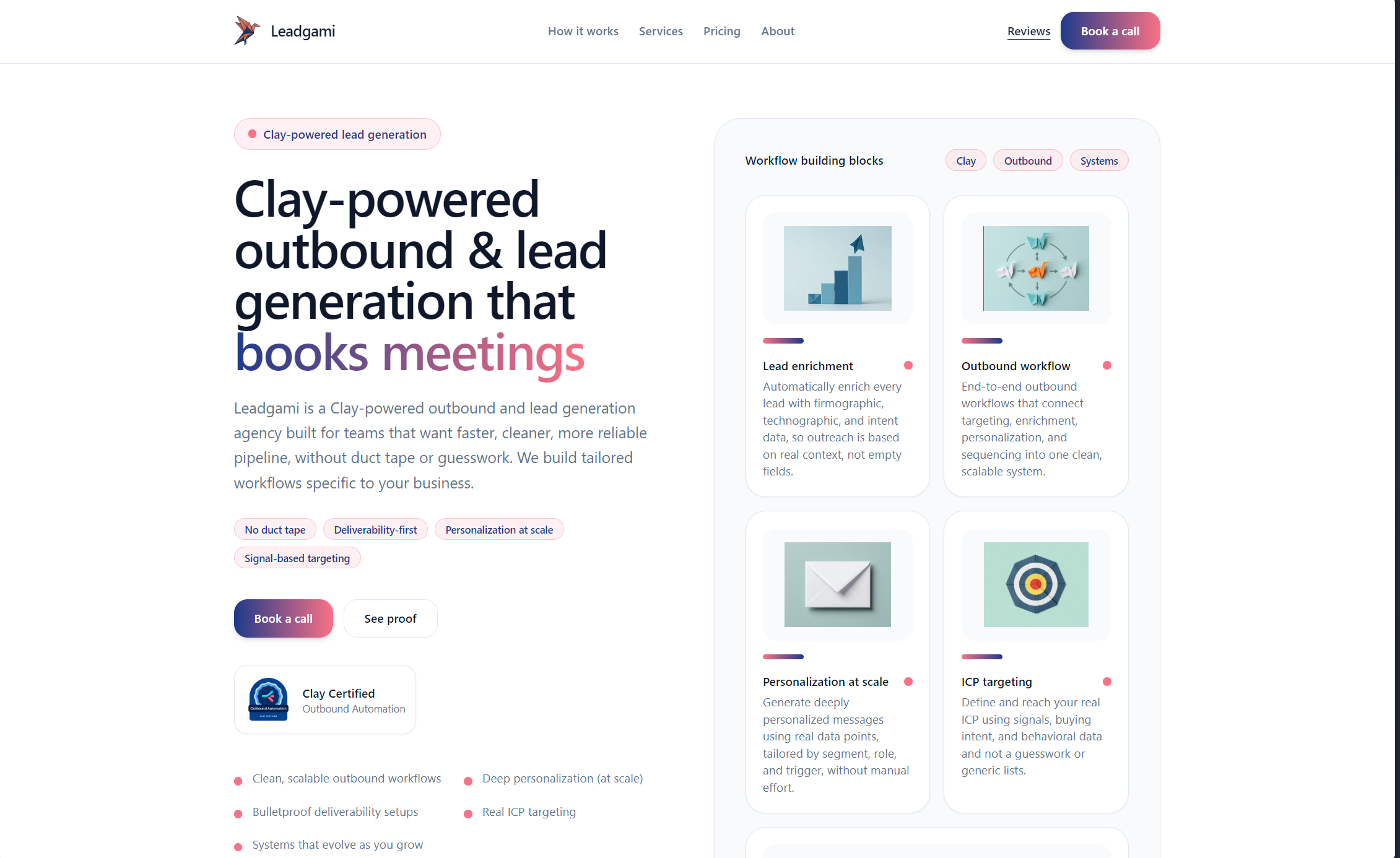
The result is a structured outbound engine that consistently generates qualified conversations and booked meetings. Whether you need us to run the system or want to build internal capability, we provide the frameworks and technology to scale your prospecting efforts. Explore the Leadgami lead generation platform to see how we help B2B SaaS companies from Seed to Series C build predictable pipeline.
FAQ
What are the most critical firmographic criteria to define an effective ICP?
Focus on company size ranging from 50-500 employees, funding stage between Series A and C, and sales team structure that matches your buyer personas. Include technology stack indicators that signal readiness for your solution category. Revenue range and growth trajectory provide additional qualification signals.
How can AI enhance prospecting efforts in SaaS sales?
AI uses intent data and pattern recognition to identify prospects actively researching solutions in your category. This enables more timely outreach when buyers are in evaluation mode rather than cold status. AI also automates data enrichment and lead scoring to help reps prioritize their efforts effectively.
What are realistic response benchmarks for cold outreach in 2026?
Average cold email reply rates hover around 4.2%, with top performers consistently achieving 6-9% through rigorous testing and personalization. Cold call success rates average approximately 2.7%. These benchmarks vary significantly by industry, deal size, and target seniority level.
When should founders lead outbound prospecting efforts?
Founders typically handle early outbound during pre-seed and seed stages to validate product-market fit and refine core messaging. This hands-on approach provides critical market intelligence that shapes product development and go-to-market strategy. Transition to dedicated sales reps once you've validated messaging and identified repeatable sales motions.