

Scaling personalized outreach remains one of the toughest challenges for B2B sales teams in 2026. Most mid-sized companies fall into the same trap: they automate everything to save time, but their messages end up feeling generic and spammy. The result is poor response rates, damaged brand perception, and wasted sales resources. This guide walks you through a proven framework to balance automation with genuine customization, helping you build an outreach process that generates qualified conversations and booked meetings consistently.
Table of Contents
- Why Personalized Outreach Matters And Common Challenges
- Preparing For Your Personalized Outreach Process
- Executing A Scalable Personalized Outreach Campaign
- Verifying And Optimizing Your Personalized Outreach Process
- Enhance Your Personalized Outreach With Leadgami
- Frequently Asked Questions About Personalized Outreach Process
Key takeaways
| Point | Details |
|---|---|
| Balance automation with customization | Over-automation damages effectiveness; strategic personalization drives engagement and conversions. |
| Apply the RIC framework | Research prospects thoroughly, Identify relevance cues, and Customize intent for each message. |
| Follow structured execution stages | Preparation, execution, and verification steps ensure scalable yet personalized outreach campaigns. |
| Measure revenue attribution | Track pipeline and closed deals rather than vanity metrics like open rates to gauge real success. |
| Iterate continuously | Regular testing and refinement of messaging elements improve response rates and lead quality over time. |
Why personalized outreach matters and common challenges
B2B buyers in 2026 receive hundreds of cold emails weekly. Generic outreach gets ignored or marked as spam immediately. Personalization is no longer optional; it's the baseline expectation for any message hoping to start a conversation. When done right, personalized outreach drives significantly higher engagement rates and conversion percentages compared to mass blasts.
The challenge most sales teams face is scaling that personalization without sacrificing quality. Many companies turn to automation tools and end up sending messages that feel robotic and irrelevant. Over-automation leads to spam perception, damaging your brand reputation and tanking response rates. Prospects can instantly tell when a message was generated by a template with their name swapped in.
The RIC framework offers a solution to this problem:
- Research: Gather meaningful insights about each prospect and their company
- Identify relevance: Find specific reasons why your solution matters to them right now
- Customize intent: Tailor your message to address their unique situation and goals
This approach ensures every message includes genuine personalization based on real context, not just surface-level details like company name or job title. It requires more upfront work but delivers dramatically better results.
Most teams also focus on the wrong metrics. Open rates and click rates feel good but don't predict revenue. A message with a 40% open rate that generates zero meetings is worthless. You need to prioritize revenue attribution throughout your outreach process, tracking which campaigns and messages actually contribute to pipeline and closed deals.
"The biggest mistake in B2B outreach is optimizing for activity metrics instead of revenue outcomes. Opens and clicks don't pay the bills."
Preparing properly before launching campaigns prevents wasted effort and protects your sender reputation. Rushing into outreach without the right foundation guarantees poor results and potential deliverability issues that take months to fix.
Preparing for your personalized outreach process
Effective personalized outreach starts long before you send the first message. You need accurate data, clear processes, the right tools, and defined success metrics. Skipping preparation steps leads to campaigns that feel generic despite your best intentions.

Start by collecting high-quality lead data. You need more than names and email addresses. Gather information about company size, recent funding rounds, technology stack, hiring patterns, and any signals indicating they might need your solution soon. The RIC framework requires deep research to identify genuine relevance, so invest time in building comprehensive prospect profiles.
Define clear roles within your team. Someone needs to own lead research and qualification. Another person should manage message creation and personalization. A third might handle technical setup and deliverability monitoring. For smaller teams, one person might wear multiple hats, but responsibilities must be explicit to avoid gaps.
Choose tools that enable customization at scale. You need platforms that support dynamic personalization tokens, conditional content blocks, and easy A/B testing. Avoid tools that force you into rigid templates. Look for solutions that integrate with your CRM and lead research techniques to pull relevant data automatically.
| Preparation element | Technology or resource | Purpose |
|---|---|---|
| Lead data collection | Clay, ZoomInfo, LinkedIn Sales Navigator | Source accurate contact information and firmographic details |
| Research automation | Web scraping tools, news aggregators, intent data platforms | Identify relevance signals and recent company developments |
| Message personalization | Email sequencing platforms with dynamic fields | Customize content at scale while maintaining quality |
| Deliverability management | Email warm-up services, domain health monitors | Protect sender reputation and inbox placement rates |
| Performance tracking | CRM with revenue attribution, analytics dashboards | Measure real business impact beyond vanity metrics |
Prepare message templates with clearly marked customization zones. Your templates should include placeholders for prospect-specific research, company-specific relevance, and personalized intent statements. Never send a template as-is; every message requires human review and customization before sending.
Clarify your success metrics upfront. Focus on revenue-related KPIs like meetings booked, opportunities created, and pipeline generated. Track response rates and engagement as secondary indicators, but always tie them back to business outcomes. Set realistic benchmarks based on your industry and target audience.
Pro Tip: Before launching any campaign, manually verify a sample of 20 to 30 leads to check data accuracy and ensure your research process surfaces genuinely relevant insights. Bad data ruins even the best personalization strategy.
Executing a scalable personalized outreach campaign
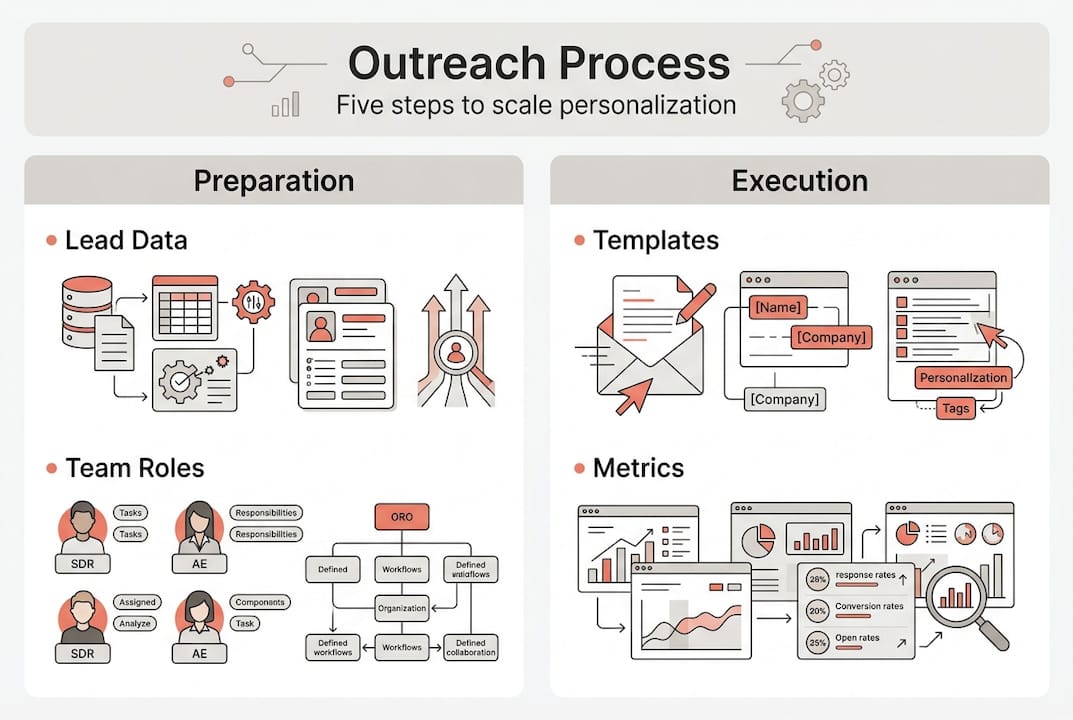
Once preparation is complete, you can launch campaigns that balance scale with genuine personalization. The execution phase requires discipline to maintain quality while processing high volumes of prospects. Follow these steps to implement the RIC framework effectively:
-
Conduct thorough lead research and segmentation. Group prospects by industry, company size, role, and specific challenges they likely face. Look for shared characteristics that allow you to personalize at the segment level while still adding individual touches. Identify 3 to 5 segments to start, then expand as you refine your process.
-
Identify relevance cues for each target segment. Research recent company news, funding announcements, leadership changes, product launches, or hiring patterns. Find specific reasons why your solution matters to each prospect right now. Generic relevance like "you work in sales" is worthless. Specific relevance like "you just hired 10 new SDRs and need to ramp them quickly" opens conversations.
-
Customize messaging intent to address prospect needs. Write your core message, then adjust the framing, examples, and call to action based on what matters most to each segment. A VP of Sales cares about team productivity and quota attainment. A Sales Operations Manager cares about process efficiency and data accuracy. Speak to their specific priorities.
-
Automate sending with personalization tokens but avoid mass generic blasts. Use your tools to insert prospect name, company name, relevant news items, and other dynamic fields. But always review messages before they go out. Automation should speed up execution, not replace human judgment. Send in smaller batches to monitor results and catch issues early.
-
Monitor revenue-related KPIs rather than only open rates. Track which messages generate replies, which replies turn into meetings, and which meetings advance to opportunities. Measure revenue attribution to understand true campaign performance. Ignore vanity metrics that don't correlate with business outcomes.
| Approach | Generic automation | RIC-based personalization |
|---|---|---|
| Research depth | Surface-level data scraping | Deep prospect and company analysis |
| Message relevance | Company name and role only | Specific triggers and contextual fit |
| Customization level | Template with name swap | Tailored intent and examples per segment |
| Response rate | 1 to 3 percent typical | 8 to 15 percent achievable |
| Meeting conversion | Low, mostly unqualified | High, with strong intent signals |
| Sender reputation impact | Degrades over time from spam reports | Maintains health through engagement |
The comparison shows why investing in personalization pays off. Higher response rates mean more conversations with less volume. Better qualification means your sales team spends time on prospects who actually fit your ideal customer profile. Stronger sender reputation protects your ability to reach inboxes long term.
Pro Tip: Set a hard limit on daily send volume when starting new campaigns. Begin with 50 to 100 emails per day, then scale gradually as you confirm deliverability and response quality. Ramping too fast triggers spam filters and tanks your sender reputation before you can course correct.
Continuously refine your messages based on feedback. When prospects reply with objections or questions, update your templates to address those points proactively. When certain relevance cues generate strong responses, emphasize them more. Treat outreach as an iterative process, not a set-it-and-forget-it campaign. Your B2B lead generation workflows should evolve weekly based on real performance data.
Verifying and optimizing your personalized outreach process
Launching campaigns is just the beginning. Ongoing measurement, analysis, and optimization separate mediocre outreach from programs that consistently generate pipeline. You need systematic processes to evaluate performance and improve results over time.
Track revenue generated from outreach to assess true impact. Connect your outreach platform to your CRM so you can attribute closed deals back to specific campaigns and messages. Calculate return on investment by comparing revenue generated against the cost of tools, data, and team time. Measure outreach success using revenue attribution rather than activity metrics that don't predict business outcomes.
Analyze replies and engagement qualitatively to identify message strengths and weaknesses. Read every response, even the negative ones. Look for patterns in objections, questions, and interest signals. If multiple prospects ask the same question, your message probably lacks clarity on that point. If prospects consistently mention a specific pain point, emphasize it more prominently in future messages.
Troubleshoot low response rates systematically:
- Verify lead data accuracy and ensure you're reaching real decision makers
- Review message relevance to confirm you're addressing genuine prospect needs
- Check deliverability metrics to rule out spam filter issues
- Test different subject lines and opening hooks to improve open rates
- Shorten message length if prospects aren't reading to the call to action
- Adjust send timing based on when your audience is most responsive
Use A/B testing on message personalization elements to identify what works. Test one variable at a time: subject line approach, opening hook style, relevance example type, call to action framing. Run tests with statistically significant sample sizes before declaring a winner. Small sample tests lead to false conclusions and wasted optimization effort.
Schedule follow-ups strategically without overwhelming prospects. A good sequence includes 3 to 5 touchpoints spread over 2 to 3 weeks. Each follow-up should add new value or a different angle, not just repeat the first message. Reference your previous outreach briefly, then introduce a fresh reason to connect. Stop after the final touchpoint unless the prospect engages.
Pro Tip: Create a swipe file of your best performing messages and the specific relevance cues that generated responses. Review this file before writing new campaigns to maintain quality standards and apply proven approaches consistently.
Iterate and refine campaign elements regularly for continuous improvement. Set a weekly or biweekly cadence to review performance data, update message templates, refresh lead lists, and test new personalization approaches. Outreach effectiveness degrades over time as prospects become desensitized to your messaging patterns. Constant iteration keeps your lead generation optimization techniques fresh and effective.
Document what works and what doesn't. Build a knowledge base of successful relevance cues, message frameworks, and segment-specific approaches. Share learnings across your team so everyone benefits from collective experience. This documentation becomes increasingly valuable as you scale your outreach program and onboard new team members.
Enhance your personalized outreach with Leadgami
Building and maintaining a scalable personalized outreach process requires significant time and expertise. You need to continuously research prospects, identify relevance signals, customize messages, monitor deliverability, and optimize based on results. For many mid-sized B2B companies, this becomes a full-time job that pulls resources away from closing deals.
Leadgami automates the heavy lifting while preserving genuine personalization. We define your ideal customer profile, identify high intent signals, and use Clay to source, enrich, and score leads based on real fit. Every message gets personalized using actual context about the prospect and their company, then executed across email and LinkedIn with deliverability managed from day one. Human SDRs handle replies, and we optimize your system weekly based on performance data. The result is a structured outbound engine that consistently generates qualified conversations and booked meetings. Whether you want us to run your outreach end to end or design tailored workflows your team can own internally, we help you implement the RIC framework at scale without sacrificing quality.
Frequently asked questions about personalized outreach process
What is the RIC framework and why is it important?
The RIC framework stands for Research, Identify relevance, and Customize intent. It provides a structured approach to personalization that goes beyond surface-level details like names and job titles. By researching prospects thoroughly, identifying specific reasons your solution matters to them now, and customizing your message intent to address their unique situation, you create outreach that feels genuinely personal rather than automated. This framework prevents the spam perception that kills response rates.
How can I avoid making outreach messages feel like spam?
Focus on relevance over volume. Every message should reference something specific about the prospect or their company that explains why you're reaching out now. Avoid generic value propositions that could apply to anyone. Keep messages concise and conversational, not salesy or overly formal. Always include a clear, low-friction call to action. Most importantly, only contact prospects who actually fit your ideal customer profile rather than blasting everyone in a database.
What metrics should I track to measure outreach success?
Prioritize revenue attribution above all else. Track meetings booked, opportunities created, pipeline generated, and deals closed from your outreach campaigns. These metrics directly correlate with business impact. Secondary metrics like response rate and positive reply rate help you understand message effectiveness, but never optimize for opens or clicks alone. Those vanity metrics often move in the opposite direction of revenue, leading teams to double down on ineffective approaches.
Are automation tools helpful or harmful in personalization?
Automation tools are essential for scaling personalized outreach, but only when used correctly. They should handle repetitive tasks like data enrichment, email sending, and follow-up sequencing while humans focus on research, message customization, and reply handling. The danger comes when teams automate everything including the thinking. Use tools to execute your personalization strategy faster, not to replace the strategic work that makes personalization effective.
How often should I update or test outreach messaging?
Review and refine your messaging weekly or biweekly based on performance data. Run A/B tests continuously on one variable at a time, giving each test enough volume to reach statistical significance before making changes. Update templates immediately when you identify common objections or questions in prospect replies. Refresh your relevance research monthly as company situations and market conditions change. Consistent iteration prevents your outreach from becoming stale and keeps response rates healthy over time.