

Many sales leaders believe outbound is broken, yet companies using modern multichannel strategies see reply rates triple and pipeline coverage stabilize at healthy ratios. The difference isn't whether outbound works in 2026, it's how you execute it. Signal-based targeting, AI-enhanced personalization, and coordinated sequences across email, phone, and social channels have replaced spray-and-pray volume tactics. This guide explores actionable trends transforming outbound into a reliable pipeline engine for mid-sized B2B companies seeking consistent lead generation and predictable revenue growth.
Table of Contents
- The Evolution Of Outbound: Why Traditional Methods Fall Short In 2026
- Multichannel Outbound Sequences: Boosting Reply And Meeting Rates Effectively
- Signal-Based And Trigger-Based Prospecting: Targeting Smarter For Higher Conversions
- Leveraging Ai For Personalization And Workflow Automation In Outbound Sales
- Benchmark Metrics And Best Practices For Mid-Sized B2B Companies
- Explore Leadgami's Tools For Transforming Your 2026 Outbound Strategy
- Frequently Asked Questions About B2B Outbound Trends 2026
Key takeaways
| Point | Details |
|---|---|
| Multichannel sequences dominate | Coordinated touchpoints across email, phone, and LinkedIn triple reply rates compared to single-channel approaches. |
| Signal-based prospecting wins | Targeting prospects based on funding, hiring, or leadership changes yields 18% reply rates versus 3.4% for generic outreach. |
| AI-human hybrid teams excel | Sales reps using AI assistance are 3.7 times more likely to hit quota than those relying solely on manual processes. |
| Cost efficiency improves | Well-executed multichannel campaigns reduce cost per meeting to $150-400, far below traditional $500-700 benchmarks. |
| Quality beats volume | Mid-sized companies achieve better results with fewer, highly targeted touches than mass generic campaigns. |
The evolution of outbound: why traditional methods fall short in 2026
Outbound sales isn't dead, but the tactics that worked five years ago now produce dismal results. Generic email blasts to purchased lists generate reply rates below 2%, waste seller time, and damage brand reputation. The problem isn't the channel itself, it's the approach. Which B2B sales outreach strategies actually work in 2026 reveals a clear divide: some experts claim outbound is broken and push pure inbound strategies, while others demonstrate that hybrid multichannel approaches work when relevant and properly timed. The consensus? Generic volume fails, but quality systems succeed.
Traditional outbound relied on three flawed assumptions. First, more touches always equal better results. Second, email alone suffices for initial contact. Third, any prospect matching basic firmographic criteria deserves outreach. These beliefs created a race to the bottom where sales teams sent hundreds of generic messages daily, hoping a few would stick. Buyers grew numb to templated pitches, spam filters became more aggressive, and deliverability rates plummeted.
Modern outbound flips this model entirely. Instead of blasting thousands of contacts, successful teams in 2026 identify smaller pools of high-intent prospects using real-time signals. They coordinate messages across multiple channels, ensuring each touchpoint adds value rather than repeating the same ask. They invest heavily in deliverability infrastructure, treating email reputation as a strategic asset. Most importantly, they recognize that timing and relevance matter far more than sheer volume.
Common mistakes still plague many outbound programs:
- Ignoring email authentication protocols like SPF, DKIM, and DMARC, leading to inbox placement rates below 50%
- Purchasing contact lists instead of building proprietary databases enriched with behavioral and firmographic signals
- Using identical messaging across all prospects without customizing for industry, role, or current business context
- Failing to coordinate outreach across channels, resulting in disconnected touchpoints that confuse rather than engage
- Neglecting response handling, leaving interested prospects waiting days for follow-up while reps chase new leads
Mid-sized companies face unique challenges in this landscape. They lack the brand recognition of enterprise players but need consistent pipeline to hit growth targets. They can't afford massive SDR teams yet require sophisticated b2b lead generation with AI tools to compete. The solution lies in adopting proven frameworks that balance automation with personalization, leveraging technology without losing the human touch that builds trust.
Multichannel outbound sequences: boosting reply and meeting rates effectively
Single-channel outreach leaves money on the table. Multi-channel outreach sequence insights 2026 data shows that multichannel outbound sequences with 5-12 touches over 14-22 days outperform single-channel approaches by 3x on reply rates and reduce cost per meeting to $150-400. A typical high-performing sequence includes email, phone calls, LinkedIn connection requests, and social engagement spread across two to three weeks. This cadence maintains presence without overwhelming prospects.
The structure matters as much as the channel mix. Successful sequences follow a pattern: initial value-driven email, LinkedIn connection with personalized note, follow-up email addressing a specific pain point, phone call referencing previous touchpoints, video message demonstrating understanding of their business, final breakup email offering to reconnect when timing improves. Each touch builds on the last, creating a narrative arc that demonstrates persistence and genuine interest.

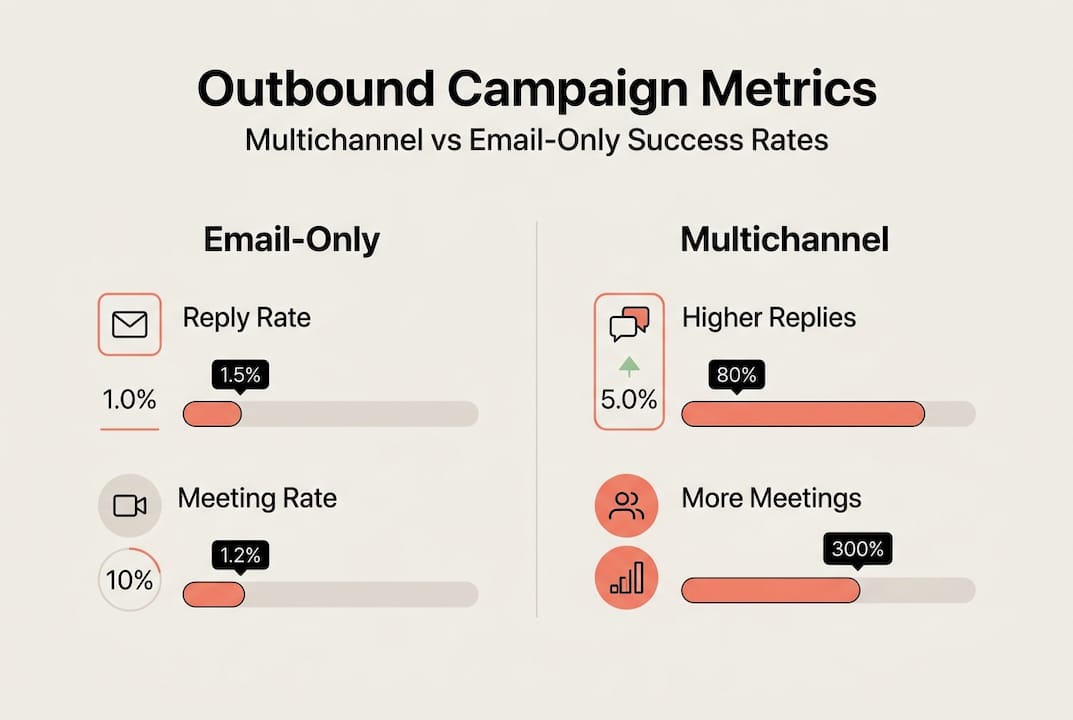
Reply rates tell the story clearly. Email-only campaigns generate 5-12% replies when well-executed, dropping to 1-3% for generic blasts. Adding phone and LinkedIn pushes replies to 12-18% and meeting bookings to 3-6%. Sequence response rates between 15-25% become achievable with proper targeting and message quality. The math shifts dramatically: instead of contacting 1,000 prospects to book 20 meetings, you contact 200 and book 25.
| Metric | Email Only | Multichannel | | --- | --- | | Reply Rate | 5-12% | 12-18% | | Meeting Rate | 1-3% | 3-6% | | Cost Per Meeting | $500-700 | $150-400 | | Touches Required | 3-5 | 5-12 |
Conditional logic separates good sequences from great ones. When a prospect replies asking for more information, the sequence should automatically shift to a nurture track. If they mention a colleague who handles purchasing decisions, trigger a referral workflow. If they object on timing, move them to a long-term follow-up cadence with quarterly check-ins. This responsiveness prevents awkward situations where automated emails continue after a conversation has started.
Pro Tip: Avoid multichannel sequences for deals under $10,000 annual contract value. The cost per meeting, even at $150-400, doesn't justify the investment when deal sizes are small. Reserve this approach for mid-market and enterprise opportunities where a single customer justifies significant acquisition spend.
AI-powered multichannel sales workflows enable teams to execute these complex sequences at scale without losing personalization. The key is balancing automation with customization, using technology to handle logistics while humans craft messaging that resonates with specific buyer contexts.
Signal-based and trigger-based prospecting: targeting smarter for higher conversions
Timing transforms outbound effectiveness. Reaching out when prospects actively experience the problem you solve yields dramatically better results than cold contact during stable periods. Signal-based prospecting monitors real-time events like funding announcements, executive hiring, office expansions, technology stack changes, and competitive losses. These triggers indicate shifting priorities and open buying windows.
Top B2B lead generation trends of 2026 research demonstrates that signal-based prospecting yields 18% reply rates versus 3.4% for generic approaches, achieves 47% better conversions from reply to meeting, and closes deals 43% larger on average. The difference stems from relevance. A company that just raised Series B funding needs solutions to scale operations. A business that hired a new CTO is likely reevaluating technology vendors. A firm posting multiple sales roles probably needs tools to ramp new reps faster.
Common high-value signals include:
- Funding rounds above $5 million, indicating budget availability and growth initiatives
- Leadership changes in roles related to your solution category, creating opportunities to establish new vendor relationships
- Rapid headcount expansion, particularly in departments that use your product or service
- Technology adoption visible through job postings, case studies, or integration partnerships
- Negative reviews or public complaints about current solutions in your category
The impact shows clearly in side-by-side comparisons:
| Approach | Reply Rate | Meeting Rate | Avg Deal Size | | --- | --- | --- | | Generic Outreach | 3.4% | 0.8% | $28,000 | | Signal-Based | 18% | 4.2% | $40,000 |
Implementing signal-based prospecting requires three components. First, data sources that capture relevant triggers in near real-time. Second, enrichment processes that add context around why the signal matters for this specific prospect. Third, rapid response workflows that reach out within 24-48 hours while the trigger remains fresh and relevant. Delays kill effectiveness because competitors monitoring the same signals move quickly.
Pro Tip: Combine signal-based triggers with multichannel outreach for maximum effect. When you identify a high-value signal, launch a coordinated sequence across email, phone, and LinkedIn rather than sending a single message. The signal justifies the investment, and the multichannel approach ensures your message breaks through.
Signal-based lead generation platforms integrate with data providers, CRM systems, and outreach tools to automate trigger detection and campaign launch. This infrastructure lets small teams punch above their weight, competing effectively against larger sales organizations through superior timing and relevance.
Leveraging AI for personalization and workflow automation in outbound sales
AI transforms how sales teams operate, but not by replacing humans. The highest-performing approach combines AI capabilities with human judgment, using technology to handle research, draft initial messages, and optimize timing while sellers focus on relationship building and deal strategy. B2B sales trends 2026 report findings show that AI integration with human oversight yields 3.7x likelihood of hitting quota, triples response rates, and increases leads by over 50%.
AI excels at three specific applications in outbound sales. First, hyper-personalization based on data signals and behavior patterns. AI analyzes prospect websites, social media activity, news mentions, and technology stack to generate customized talking points for each contact. Second, sequence optimization that adjusts send times, channel selection, and message content based on response patterns. Third, agentic workflows that automate repetitive tasks like data entry, list building, and follow-up scheduling while flagging situations requiring human intervention.
The personalization capability matters most for mid-sized companies. Instead of generic templates mentioning company name and industry, AI-generated messages reference specific initiatives, recent hires, technology investments, and competitive positioning. A message to a VP of Sales might mention their company's recent expansion into the Southwest region, note job postings for account executives in Phoenix and Austin, and offer insights on ramping new reps in distributed teams. This level of customization was economically impossible at scale before AI.
Key applications include:
- Prospect research that synthesizes information from dozens of sources into actionable talking points
- Message generation that maintains brand voice while customizing content for individual recipients
- Response classification that routes replies to appropriate team members based on intent and urgency
- Performance analysis that identifies which messages, sequences, and targeting criteria drive best results
Pro Tip: Regularly monitor AI outputs to maintain natural, non-robotic outreach tone. AI sometimes generates technically accurate but awkwardly phrased messages that signal automation. Have experienced reps review samples weekly and provide feedback to refine prompts and templates.
AI hybrid sellers are 3.7x more likely to meet quota than non-AI peers.
The human role remains critical. Sellers provide strategic direction, handle complex objections, build relationships during calls and meetings, and make judgment calls on deal qualification. AI handles the grunt work that consumed hours daily: finding contact information, researching company backgrounds, drafting initial outreach, logging activities, and scheduling follow-ups. This division of labor lets each rep manage larger territories without sacrificing quality.
AI-powered sales automation platforms integrate these capabilities into unified workflows, ensuring AI assistance feels seamless rather than bolted on. The result is higher productivity without the robotic feel that turns prospects away.
Benchmark metrics and best practices for mid-sized B2B companies
Understanding what good looks like helps sales leaders set realistic targets and identify improvement opportunities. B2B sales trends benchmarks 2026 data establishes clear performance ranges: reply rates of 5-12% for personalized outreach versus 1-5% for generic, meeting bookings of 1-3%, cost per meeting between $150-700 depending on deal size and market, and pipeline coverage ratios of 3:1 to support consistent quota attainment.
| Metric | Target Range | Best-in-Class | | --- | --- | | Reply Rate | 8-15% | 15-22% | | Meeting Rate | 2-4% | 4-6% | | Cost Per Meeting | $200-500 | $150-300 | | MQL to SQL % | 25-40% | 40-55% | | Win Rate | 15-25% | 25-35% | | Pipeline Coverage | 3:1 | 4:1 |
These benchmarks vary by industry, deal size, and sales cycle length. Enterprise software with $100,000+ deals tolerates higher cost per meeting than SMB SaaS at $10,000 annual contracts. Complex solutions with nine-month sales cycles need deeper pipeline coverage than transactional products closing in 30 days. Use these ranges as starting points, then refine based on your specific market dynamics.
Operational best practices for mid-sized companies:
- Maintain rigorous data hygiene with quarterly list cleaning, removing bounces, unsubscribes, and unresponsive contacts to protect deliverability
- Integrate inbound and outbound motions so website visitors, content downloaders, and event attendees receive coordinated follow-up across channels
- Use conditional logic in sequences to handle common responses like referrals, timing objections, and feature questions without manual intervention
- Conduct continuous training on new tools, messaging frameworks, and competitive positioning to keep reps sharp and consistent
- Apply human oversight to AI activities through weekly sample reviews, prompt refinement, and output quality checks
Deliverability infrastructure deserves special attention. Companies achieving inbox placement above 85% implement proper email authentication, warm new sending domains gradually, monitor spam complaint rates obsessively, and maintain clean lists. Those ignoring these fundamentals see messages land in spam folders regardless of content quality, wasting effort and budget.
Pro Tip: Align pipeline coverage ratio at 3:1 to support consistent quota attainment. This means maintaining three times your quarterly revenue target in qualified pipeline at all times. Lower coverage creates feast-or-famine cycles, while higher coverage may indicate weak qualification or unrealistic deal values.
B2B sales benchmarks and tools help teams track performance against industry standards, identify gaps, and prioritize improvements that move the needle on revenue outcomes.
Explore Leadgami's tools for transforming your 2026 outbound strategy
Implementing modern outbound strategies requires the right technology foundation. Leadgami builds end-to-end outbound systems that turn inconsistent outreach into reliable pipeline for B2B companies. We define your ideal customer profile, identify high-intent signals, and use Clay to source, enrich, and score leads based on actual fit rather than guesswork.
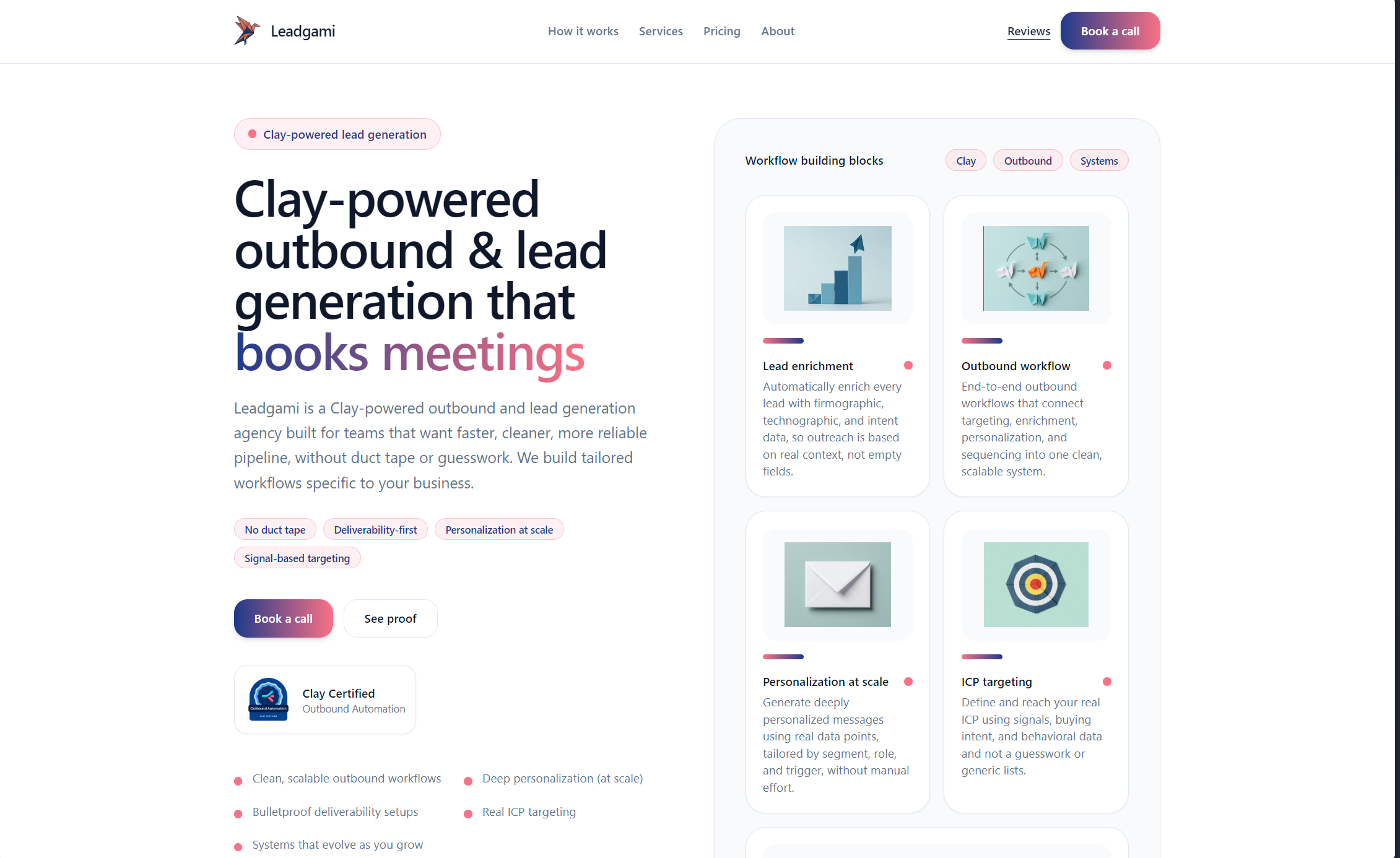
Every message gets personalized using real context about the prospect's business, then executed across email and LinkedIn with deliverability handled from day one. Replies are managed by human SDRs who understand your product and market. The system is continuously optimized weekly based on performance data, ensuring your outbound engine improves over time rather than degrading.
We also design tailored outbound workflows your team can own and operate internally, from job-based prospecting systems for recruiters to signal-driven campaigns tied to your go-to-market motion. The result is a structured outbound engine that consistently generates qualified conversations and booked meetings, with or without us in the loop. Leadgami B2B lead generation and automation transforms outbound from a frustrating numbers game into a predictable revenue driver.
Frequently asked questions about B2B outbound trends 2026
What are the main benefits of multichannel outbound in 2026?
Multichannel sequences triple reply rates compared to email-only approaches while reducing cost per meeting by 40-60%. They create multiple touchpoints that build familiarity and demonstrate persistence, increasing the likelihood prospects engage when timing aligns with their needs.
How does signal-based prospecting improve sales outcomes?
Targeting prospects experiencing relevant business events like funding, hiring, or leadership changes yields 18% reply rates versus 3.4% for generic outreach. Signal-based approaches also produce 47% better conversion rates and 43% larger deal sizes because you reach buyers during active evaluation periods.
Can AI fully replace human sales reps in outbound?
No, the best results come from AI-human hybrid teams where technology handles research, personalization, and workflow automation while humans focus on relationship building and strategic selling. Hybrid sellers are 3.7 times more likely to hit quota than those using either AI alone or purely manual processes.
What cost benchmarks should mid-sized companies expect per meeting?
Well-executed multichannel campaigns achieve $150-400 cost per meeting for mid-market deals, compared to $500-700 for traditional approaches. Costs vary based on deal size, market competitiveness, and internal versus outsourced execution.
How often should outbound performance metrics be reviewed?
Weekly reviews of reply rates, meeting bookings, and sequence performance allow rapid optimization and prevent small issues from becoming major problems. Monthly deep dives into pipeline coverage, conversion rates, and cost efficiency ensure strategic alignment with revenue goals.