

Automation in B2B outreach promises efficiency, scale, and consistent activity. Yet many sales leaders discover that over-automation erodes engagement quality, tanks reply rates, and creates robotic messaging that prospects ignore. The challenge is not whether to automate, but how much automation delivers results without sacrificing the human nuance that drives real conversations. This guide reveals the balance between automation efficiency and authentic engagement, showing you exactly when automation accelerates growth and when it undermines your outreach effectiveness.
Table of Contents
- Key takeaways
- Understanding the role of automation in B2B outreach
- Risks and pitfalls of over-automation in outbound sales
- Navigating nuances: best practices for hybrid automation strategies
- Applying automation effectively for scalable and sustainable growth
- Discover Leadgami's solutions for automating B2B sales outreach
- Frequently asked questions about automating B2B outreach
Key Takeaways
| Point | Details |
|---|---|
| Balance automation with human oversight | Use automation to handle repetitive tasks while keeping human review for context, personalization, and complex conversations. |
| Targeted automation ROI | Targeted automation delivers strong returns by focusing outreach on qualified prospects rather than blasting broad audiences. |
| Hybrid guardrails reduce risk | Hybrid approaches with guardrails limit over automation and preserve human judgment in messaging strategy. |
| Cap automated volume | Cap daily automated sends to fifty to seventy five per sender to preserve deliverability and drive quality. |
Understanding the role of automation in B2B outreach
Automation in B2B outreach refers to tools and workflows that execute repetitive sales tasks without manual intervention. Email sequencing platforms send personalized messages at scale. CRM integrations track prospect interactions automatically. LinkedIn automation tools schedule connection requests and follow-ups. These systems let sales teams reach hundreds of prospects daily instead of dozens.
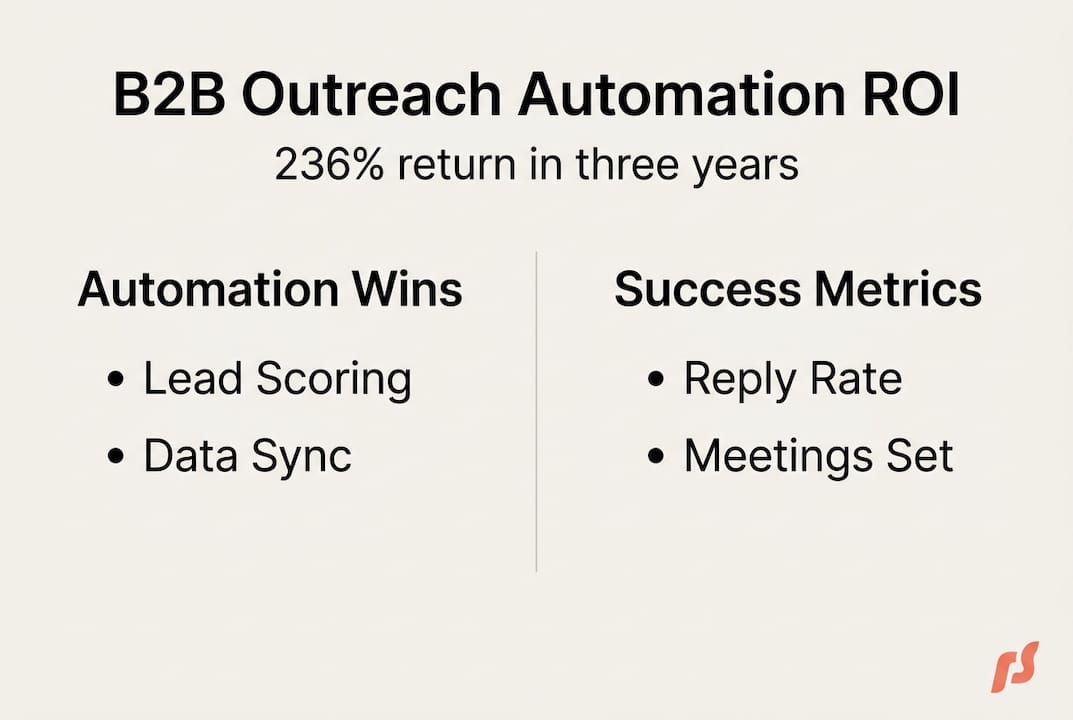
The appeal is undeniable for growth professionals at mid-sized companies. You face pressure to generate pipeline while managing limited SDR resources. Automation multiplies your team's capacity without proportional headcount increases. When executed correctly, targeted automation delivers 236% ROI over three years. Cold email generates 82 times the return of paid ads when campaigns focus on qualified prospects who match your ideal customer profile.
Common automation tactics include:
- Multi-touch email sequences triggered by prospect behavior
- Automated LinkedIn connection requests with personalized notes
- CRM workflows that assign tasks based on engagement signals
- Calendar scheduling links that eliminate back-and-forth coordination
- Follow-up reminders that ensure consistent prospect nurturing
The critical distinction separates activity from outcomes. Many teams automate to boost email volume or connection requests sent. These vanity metrics create illusions of productivity while actual pipeline stays flat. Smart automation focuses on qualified meetings booked, not messages dispatched. You want systems that identify high-intent prospects, personalize outreach based on real context, and trigger human involvement at optimal moments.
B2B lead generation workflows succeed when automation handles data enrichment, lead scoring, and sequence execution while humans craft messaging strategy, review edge cases, and manage actual conversations. The technology scales your reach. Your judgment ensures relevance.
Risks and pitfalls of over-automation in outbound sales
Excessive automation transforms outreach into spam. When every message follows identical templates with minimal personalization, prospects recognize the pattern instantly. Your emails land in spam folders or get deleted without reading. Reply rates plummet because recipients sense they are interacting with a machine, not a person who understands their specific challenges.
Over-automation leads to robotic messaging, deliverability erosion, SDR skill decline, and lower reply rates. Sender reputation suffers when automation sends high volumes without proper warming protocols or engagement monitoring. Email providers flag your domain as a spam source. Even well-crafted messages never reach inboxes because your sender score has tanked.
Key consequences of automation overuse:
- Generic messaging that fails to address prospect-specific pain points
- Deliverability collapse as spam filters block your domain
- SDR skill atrophy when reps never practice research or personalization
- Decreased reply rates as prospects ignore obviously automated outreach
- Compliance violations when automation bypasses opt-out requests
Pro Tip: Set volume limits on automated sequences. Cap daily sends at 50-75 emails per sender to maintain deliverability and force quality over quantity.
The human cost matters as much as the technical damage. SDRs who rely entirely on automation never develop crucial skills like prospect research, pain point identification, or conversation adaptation. They become button-pushers who launch sequences without understanding why certain messages work. When automation fails or prospects require nuanced responses, these reps lack the judgment to course correct.
"The biggest mistake is treating automation as a replacement for sales skill rather than an amplifier of it. Your team still needs to know what good outreach looks like."
Smart B2B lead generation systems use automation to handle repetitive tasks while preserving human judgment for strategy, personalization review, and relationship building. The goal is leverage, not replacement.

Navigating nuances: best practices for hybrid automation strategies
Hybrid automation combines machine efficiency with human judgment. The system handles data processing, sequence execution, and activity tracking. Humans make strategic decisions, review message quality, and manage actual conversations. This approach delivers scale without sacrificing the authenticity that drives engagement.
Best practices for balanced automation:
- Implement human-in-the-loop reviews for all new sequences before launch
- Personalize at least three elements per message using prospect-specific context
- Set compliance guardrails that automatically honor opt-outs and regional regulations
- Monitor reply sentiment, not just reply rates, to catch messaging problems early
- Train SDRs on both automation tools and manual outreach fundamentals
- Reserve high-value enterprise prospects for fully manual, research-heavy outreach
Edge cases require human oversight. Over-automation fails in nuanced cultural contexts, compliance scenarios like GDPR, and high-value enterprise deals where generic messaging destroys credibility. Mitigate these risks with human-in-the-loop checkpoints, regulatory guardrails, and hybrid models that route complex situations to experienced reps.
| Approach | Pros | Cons | Best for |
|---|---|---|---|
| Fully automated | Maximum scale, minimal labor cost | Generic messaging, compliance risks | High-volume SMB outreach |
| Hybrid automation | Balanced scale and quality | Requires process design | Mid-market focused campaigns |
| Manual outreach | Highest personalization | Limited scale, high cost | Enterprise accounts, strategic deals |
Pro Tip: Use workflow automation in B2B sales to route prospects automatically based on deal size. Enterprise prospects get manual research and custom messaging. SMB leads enter automated sequences with dynamic personalization tokens.
Cultural sensitivity matters more as you scale internationally. Messaging that works in North America may offend prospects in Asia or Europe. Automated translations often miss nuance. Hybrid systems let native speakers review messaging for cultural appropriateness before sequences launch. This prevents embarrassing mistakes that damage brand reputation across entire markets.
Compliance guardrails protect you from legal exposure. Automated systems must respect GDPR consent requirements, CAN-SPAM opt-out requests, and industry-specific regulations. Build these rules into your automation logic so the system cannot violate them even if a rep makes a mistake. For more on optimizing these workflows, explore B2B lead generation workflow optimization.
Applying automation effectively for scalable and sustainable growth
Smart implementation starts with clear objectives tied to revenue outcomes. Define what success looks like before building automation workflows. Are you optimizing for qualified meetings booked, pipeline generated, or closed revenue? Each goal requires different automation strategies and measurement approaches.
Practical steps for effective automation integration:
- Map your current manual outreach process to identify repetitive tasks suitable for automation
- Select tools that integrate with your existing CRM and maintain data consistency
- Build sequences with 5-7 touches over 14-21 days, mixing email and LinkedIn
- Create personalization frameworks using firmographic and behavioral data
- Establish review cycles where humans audit message performance weekly
- Train SDRs on both automation operation and manual outreach fundamentals
The right KPIs focus on quality over volume. Track these metrics to evaluate automation effectiveness:
| Metric | Target | Why it matters |
|---|---|---|
| Reply rate | 3-8% | Indicates message relevance and personalization quality |
| Positive reply rate | 1-3% | Shows genuine interest versus brush-offs |
| Meeting booking rate | 0.5-2% | Measures actual pipeline generation |
| Email deliverability | 95%+ | Confirms sender reputation remains healthy |
| Sequence completion rate | 60%+ | Reveals if prospects engage across multiple touches |
Empirical evidence shows targeted automation generates 236% ROI over three years when campaigns focus on qualified prospects. Cold email delivers 82 times the return of paid advertising. However, these results require measuring qualified meetings and pipeline created, not raw activity volume. A thousand emails sent means nothing if zero meetings result.
Iterative testing drives continuous improvement. Run A/B tests on subject lines, personalization approaches, and call-to-action phrasing. Let data reveal what resonates with your specific audience rather than copying generic best practices. What works for SaaS companies may fail for manufacturing firms. Test, measure, refine.
Maintaining SDR skills alongside automation prevents skill atrophy. Require reps to conduct manual research on high-value prospects weekly. Have them write custom messages without templates monthly. This practice keeps judgment sharp so they can adapt when automation reaches its limits. Your team should view automation as leverage for their expertise, not a replacement for developing it.
For comprehensive strategies on scaling effectively, review B2B sales upscaling tactics that complement automation with skill development. The most successful teams balance technology leverage with human capability growth. They automate the repetitive while preserving the strategic.
Sustainable growth requires monitoring sender reputation and deliverability metrics as closely as reply rates. A spike in email volume that tanks your domain reputation creates long-term damage that takes months to repair. Warm new sending addresses gradually. Monitor spam complaint rates. Maintain clean lists by removing unengaged contacts quarterly. These operational disciplines protect your ability to reach inboxes consistently.
B2B lead generation workflows that scale sustainably build feedback loops between automation performance and human strategy. When reply rates drop, humans investigate root causes and adjust messaging. When certain industries show higher engagement, automation shifts more volume toward those segments. The system learns and adapts through human-machine collaboration.
Discover Leadgami's solutions for automating B2B sales outreach
You have learned how automation can scale your outreach while preserving the human touch that drives real engagement. Implementing these strategies requires expertise in workflow design, data enrichment, and continuous optimization. That is where Leadgami transforms theory into pipeline.
Leadgami builds end-to-end outbound systems that balance automation efficiency with human judgment. We define your ideal customer profile, identify high-intent signals, and use Clay to source, enrich, and score leads based on actual fit. Every message gets personalized using real context, then executed across email and LinkedIn with deliverability handled from day one. Human SDRs manage replies while the system optimizes weekly based on performance data.
Whether you need us to run your outbound engine or want tailored workflows your team operates internally, Leadgami's B2B lead generation workflows deliver structured systems that consistently generate qualified conversations and booked meetings. Stop guessing about automation strategy. Start generating predictable pipeline.
Frequently asked questions about automating B2B outreach
How much automation is too much in B2B outreach?
Too much automation occurs when reply rates drop below 2% and positive responses fall under 0.5%. These metrics signal that messaging has become too generic or volume has damaged deliverability. The right balance maintains human oversight for strategy and message quality while automating execution and tracking. Reserve fully manual outreach for enterprise accounts and complex deals requiring deep personalization.
What metrics should I track to evaluate automation success?
Focus on qualified meetings booked, positive reply rate, and pipeline generated rather than emails sent or connections made. Track email deliverability above 95% to confirm sender reputation stays healthy. Monitor sequence completion rates above 60% to ensure prospects engage across multiple touches. These quality metrics reveal whether automation drives real business outcomes or just activity theater.
How do I handle compliance and cultural nuances with automated outreach?
Build compliance guardrails directly into automation logic that honor GDPR consent, CAN-SPAM opt-outs, and industry regulations automatically. For cultural nuances, implement human-in-the-loop reviews where native speakers approve messaging before international campaigns launch. Route high-value enterprise prospects to manual workflows that allow for relationship-specific customization. Automation should enable compliance and cultural sensitivity, not bypass them.
Does automation hurt sales team skill development?
Automation hurts skill development only when teams treat it as a replacement for sales fundamentals rather than an amplifier. Prevent atrophy by requiring SDRs to conduct manual prospect research weekly and write custom messages monthly without templates. Train teams on both automation operation and core outreach principles. The best performers use automation to scale their expertise, not substitute for developing it. Balance technology leverage with continuous skill building.